Forensic Liability Determination: Scientifically Identifying the Source
In complex overspray incidents involving multiple job sites or industrial facilities, determining the exact party responsible is critical for claim resolution. Nationwide Overspray provides a comprehensive, science-based solution for Liability Determination.
Through specialized lab analysis and environmental data, we move beyond guesswork to provide forensic proof of the contaminant’s origin.
Sample Analysis: The Chemical "Fingerprint"
Our process is capable of analyzing contaminants as small as 30–50 microns—roughly the size of a period at the end of a sentence. Because every coating has a unique chemical signature, we can match samples taken from a vehicle directly to a specific paint source or reference material.
Our Forensic Collection Process:
Integrity-First Collection: Samples are gathered using a strictly defined chain-of-custody process to ensure the integrity of the evidence.
Dot-by-Dot Analysis: Our method allows us to isolate and identify multiple different contaminants on a single surface.
Micron-Level Precision: We use high-magnification tools to extract samples without damaging the underlying vehicle finish.
What is FTIR Technology?
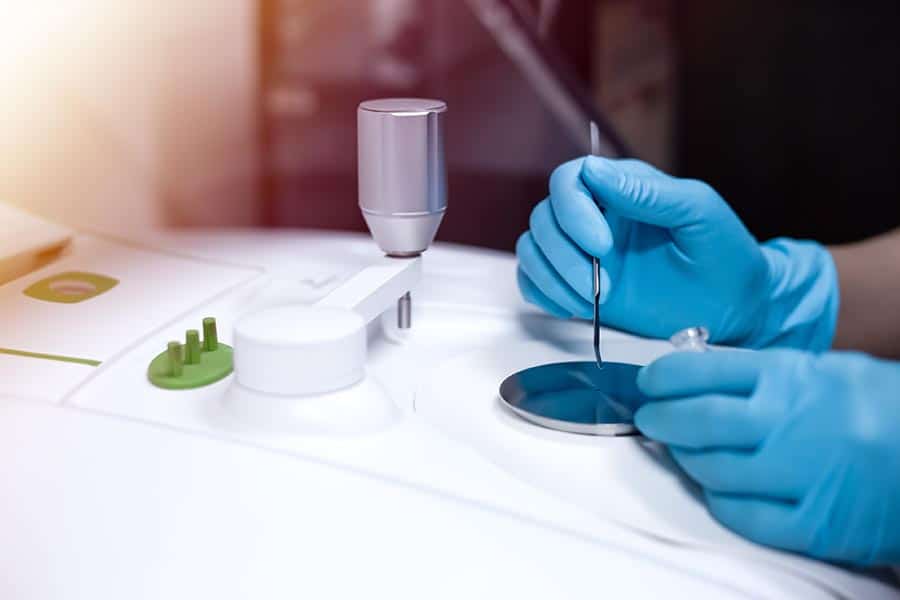
We determine responsibility using Fourier Transform Infrared Spectroscopy (FTIR). This is a sophisticated technology that identifies chemicals by measuring how they absorb infrared light.
How FTIR Works:
Infrared Exposure: The collected sample is exposed to varying wavelengths of infrared light.
Absorption Measurement: The instrument measures which specific wavelengths are absorbed by the sample.
Spectral Mapping: This creates a unique “spectra” or graph. Since no two chemical compounds absorb light in the exact same way, this acts as a chemical fingerprint.
Source Matching: We compare this fingerprint against known samples from the suspected job site to confirm a match.
Beyond the Lab: Environmental Liability Testing
While FTIR identifies what the material is, we also use environmental forensics to determine how it reached the vehicles. This data is essential for closing insurance claims and resolving disputes between contractors.
Wind Speed & Direction Records: We analyze historical meteorological data from the exact time of the reported occurrence.
Trajectory Modeling: Mapping the drift of the airborne particles based on elevation and wind gusts.
Site Proximity Analysis: Correlating the location of affected units with the suspected application site.